- Staff Editor
- Follow Me
- September 6, 2026
-
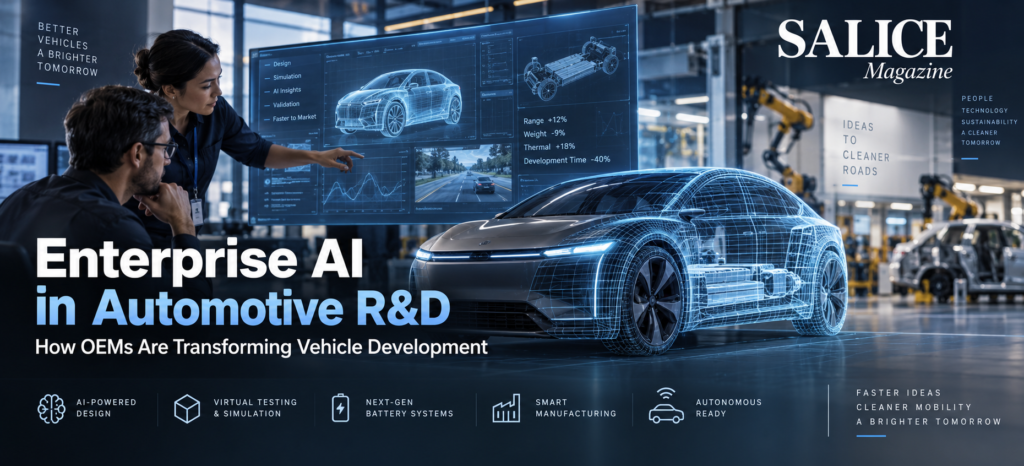
Enterprise AI in a product engineering company is the integration of AI into the end-to-end product development lifecycle to improve engineering speed, quality, cost and innovation.
It combines technologies such as machine learning, generative AI, AI agents, computer vision, optimization and predictive analytics with engineering systems including PLM, CAD, CAE, ALM, test platforms and manufacturing data.
Typical applications include requirements analysis, design optimization, code generation, simulation acceleration, defect prediction, automated testing, digital twins, knowledge retrieval, root-cause analysis and predictive maintenance.
The key difference from standalone AI tools is that enterprise AI operates across engineering functions using company-specific data, workflows, security controls and governance.
In simple terms, it enables product engineering organizations to move from AI-assisted tasks to AI-enabled engineering systems, helping teams explore more design options, validate earlier, reduce physical iterations and make better technical decisions.
Enterprise AI in Automotive Engineering
Vehicle development has traditionally been a complex, sequential and capital-intensive process. Engineers define requirements, develop concepts, create detailed designs, run simulations, build prototypes, conduct physical testing, refine the vehicle and repeat the cycle until it is ready for production. This model has produced highly reliable vehicles, but growing product complexity is putting enormous pressure on the traditional approach.
Electric vehicles, software-defined vehicles, advanced driver assistance systems, autonomous driving, connected services and increasingly complex electronics have dramatically increased the number of engineering decisions required for each new vehicle.
Enterprise AI is emerging as an important response. Rather than using artificial intelligence only as an individual productivity tool, automotive OEMs are beginning to integrate AI with their engineering data, CAD and CAE environments, PLM platforms, software-development systems, simulation infrastructure, test environments and organizational knowledge.
The objective is not simply to make engineers work faster. It is to create a more intelligent development system in which AI helps engineers explore more alternatives, predict problems earlier, automate repetitive work, accelerate validation and make better-informed engineering decisions.
Turning Engineering Knowledge Into an Intelligent Asset
Automotive companies possess decades of engineering knowledge distributed across specifications, test reports, regulations, engineering standards, supplier documents, warranty records and previous vehicle programs.
Finding the right information can consume significant engineering time. Enterprise AI can create intelligent engineering knowledge systems that allow engineers to search this information conversationally, summarize large documents, compare specifications and identify relevant lessons from previous programs.
This can also improve requirements engineering. AI can help identify inconsistencies, duplicate requirements, missing dependencies and potential conflicts between vehicle functions.
The result is an important shift, engineering knowledge becomes reusable rather than remaining trapped inside documents, departments or individual experts.
BMW says it already uses AI in engineering to analyze specification documentation, technical standards and regulations. BMW also applies intelligent search to internal knowledge and supplier information to support faster, data-driven decisions.
Accelerating Concept Design With Generative AI
The earliest stage of vehicle development has traditionally required designers and engineers to create and evaluate multiple concepts before selecting a feasible direction.
Generative AI can dramatically expand this design space. Designers can describe styling characteristics, proportions, packaging requirements and engineering constraints, while AI generates numerous alternatives. Engineers can then evaluate the most promising concepts rather than manually creating every variation.
The real opportunity comes when generative design is connected with engineering parameters. Instead of generating visually attractive images alone, AI can incorporate aerodynamic, packaging or structural considerations during concept development. This creates a tighter connection between styling creativity and engineering feasibility.
Toyota has demonstrated AI-supported vehicle styling in which generated designs consider aerodynamic constraints. Toyota Research Institute’s AiEVA tool combines generative AI with estimated drag coefficients to help teams explore aerodynamic vehicle concepts. GM similarly says it is using AI from the initial sketch stage to generate and evaluate more design alternatives earlier.
Transforming CAE Through AI Accelerated Simulation
Computer aided engineering is central to automotive R&D. Crashworthiness, aerodynamics, NVH, thermal performance, durability and structural behavior traditionally require computationally intensive simulations.
Enterprise AI can complement physics based CAE through surrogate models trained on previous simulation results.
AI can rapidly estimate the likely outcome instead of running a full simulation for every design change. Engineers can use those predictions to eliminate weak designs and reserve high fidelity CAE for the most promising configurations.
This does not replace physics-based engineering. It creates a faster screening layer around it. The result can be dramatically shorter engineering feedback loops and a much larger number of design iterations.
GM reports that machine learning and advanced simulation have reduced certain roof-crush analysis runs from 8–40 hours to less than five minutes. BMW is separately working with Mistral AI to analyze more than a petabyte of historical crash-simulation data using specialized Large Industry Models.
Moving Toward Virtual-First Vehicle Development
Enterprise AI becomes even more valuable when combined with digital twins and virtual engineering. A digital vehicle can represent mechanical systems, electronics, software, controls, thermal behavior and operating environments before complete physical hardware exists.
Engineers can therefore test interactions earlier and detect system-level problems before prototype construction.
The development process begins moving from:
Design → Prototype → Test → Redesign
toward:
Design → Virtualize → Simulate → Optimize → Targeted Physical Validation
Physical prototypes remain critical, particularly for safety and final validation. However, they increasingly confirm decisions rather than being the primary way engineers discover problems.
GM’s co-simulation environment connects physics based plant models with virtual controllers, allowing hardware and software behavior to be evaluated together before physical hardware is ready. Mercedes Benz also uses highly detailed digital twins of its Immendingen proving ground and can digitally evaluate more than 100 chassis variations before selecting candidates for physical testing.
Accelerating Software-Defined Vehicle Development
Software is becoming one of the largest components of modern vehicle development.
Software-defined vehicles may contain hundreds of functions covering infotainment, energy management, ADAS, body controls, connectivity and customer experiences. AI can help engineers generate code, analyze defects, create documentation, build test cases and automate regression testing.
Enterprise AI can also connect software requirements with implementation and validation environments.
This is particularly important because software development operates on much shorter cycles than traditional vehicle hardware development. OEMs therefore need engineering systems that allow software to be developed and tested even before production hardware exists.
Stellantis’ Virtual Engineering Workbench allows engineers to develop, integrate and validate software in virtual environments up to a year before production hardware is available. Stellantis reported that on its new technology platforms, 80%–85% of testing is performed using Software-in-the-Loop environments.
Automating Software Testing and Validation
Generating software faster creates little benefit if validation becomes the new bottleneck. AI can automate test creation, execute repetitive scenarios, identify abnormal behavior and prioritize failures requiring engineering attention. This is especially valuable in infotainment and connected-vehicle systems, where the number of functions, interfaces and possible user interactions can become extremely large. AI-enabled testing also supports continuous integration, allowing validation to occur whenever software changes rather than waiting for major program milestones.
Volkswagen’s proprietary GHOST system automatically tests infotainment software, including touch interactions that simulate how a person would operate the system. Volkswagen says the system produces reproducible testing, avoids documentation errors and helps accelerate release cycles. In 2025 alone, Volkswagen put more than 100 AI-based processes into productive use within Technical Development.
Expanding ADAS and Autonomous Driving Validation
ADAS and autonomous driving systems face a unique engineering challenge, the number of possible road scenarios is effectively unlimited. It is impossible to physically drive every combination of weather condition, road geometry, pedestrian behavior, traffic situation and sensor disturbance. AI and simulation allow OEMs to generate and replay millions of virtual scenarios, including dangerous and rare events that would be difficult to reproduce safely in real world testing.
Real world fleet data can identify scenarios of interest, while AI generated environments can create variations around those cases. This combination increases test coverage while reducing dependence on physical vehicles.
Volkswagen Group China has described AI simulation as a critical enabler for advanced automated driving validation, citing approximately 10 million simulated kilometers compared with around 0.1 million kilometers of real world testing in one L3 development framework. BMW also operates a large driving simulation center that reproduces rare and critical traffic scenarios before road testing.
Accelerating Battery and Materials Research
Materials research is another promising application of enterprise AI. Developing next-generation batteries requires optimization across energy density, charging performance, cycle life, safety, thermal stability and cost. Researchers may need to examine enormous numbers of material combinations and formulations.
Machine learning can help screen materials computationally before laboratory testing. AI can identify relationships in experimental and simulation data and recommend promising candidates. This can change materials research from largely sequential experimentation toward an increasingly data-driven discovery loop:
AI proposes → simulation evaluates → laboratory validates → results return to AI.
Toyota’s Global AI Accelerator, or GAIA, has specifically identified Material Discovery as one of its 11 initial areas for increased AI investment and deployment, alongside vehicle engineering, AD/ADAS, manufacturing and robotics. Toyota Research Institute has also published machine learning research related to materials prediction and high-throughput materials analysis.
Optimizing the Vehicle as One Integrated System
Optimizing the Vehicle as One Integrated System. One of the largest long term opportunities for enterprise AI is multi objective vehicle optimization. Automotive engineering involves constant trade offs.
Battery size ↔ range ↔ weight ↔ cost ↔ charging speed ↔ thermal performance ↔ crashworthiness ↔ manufacturability
Traditionally, different engineering groups optimize individual subsystems and then reconcile competing requirements.
AI can help explore much larger combinations of design parameters and identify architectures that offer the strongest overall balance.
Rather than searching for one theoretically perfect vehicle, AI can present engineers with a Pareto frontier of technically feasible options, lowest cost, longest range, lowest mass or best overall compromise.
BMW is building a multi agent engineering system in which a supervisor AI coordinates specialized engineering agents working on different technical and economic objectives. The agents exchange information and resolve trade offs, while engineers define the requirements and retain responsibility for final decisions.
Reducing Physical Prototypes and Accelerating Homologation
Physical testing remains essential, but enterprise AI and high confidence simulation can reduce how many prototypes need to be built and destroyed.
The principle is not virtual-only development, but virtual first development. Engineers can use simulation to explore thousands of possibilities and then select the most important conditions for physical verification.
This reduces prototype cost, accelerates learning and can also improve sustainability by lowering material consumption. The transformation can eventually extend beyond engineering validation into regulatory approval.
BMW announced in 2026 that some physical crash tests used for homologation in Germany could be replaced by validated virtual simulations following technical audit and recognition by German authorities. BMW says the approach saves prototypes, time, money and resources while maintaining safety requirements.
Connecting Product Development With Manufacturing Engineering
A vehicle is not successfully developed until it can be manufactured efficiently at scale. Enterprise AI and digital twins allow manufacturing engineering to become involved earlier in product development.
Assembly sequences, tooling positions, ergonomics and factory layouts can be evaluated while vehicle designs are still evolving. Engineers can detect production issues before physical equipment is installed. This creates a stronger digital thread between product design and industrialization and reduces expensive late engineering changes.
GM uses immersive virtual environments to review assembly sequences, equipment placement and ergonomics before physical installation. GM says these virtual workflows can reduce late surprises and shorten traditional commissioning timelines. Mercedes-Benz similarly combines AI and digital twins within its MO360 production environment for new vehicle launches.
From AI Assistants to Agentic Engineering
A traditional AI assistant waits for an engineer to ask a question. An agent can receive an objective, plan activities, use engineering tools, analyze results and coordinate with other agents.
A future vehicle program could involve:
Requirements Agent → Design Agent → CAE Agent → Cost Agent → Test Agent → Compliance Agent
A supervisor agent could coordinate these specialized systems while engineers establish requirements, evaluate trade offs and approve consequential decisions.
This does not remove engineers from the process. It potentially moves them toward higher value activities such as architecture, decision making and system integration.
BMW’s multi agent development initiative already uses the concept of a supervisor agent coordinating specialized engineering agents for early vehicle concepts. BMW says agentic AI can perform preparation, analysis, simulation and structuring while humans retain responsibility for the outcome.
Conclution
The competitive advantage will not come from giving every engineer access to a generic chatbot. Successful automotive enterprise AI requires an integrated foundation:
Engineering data + AI models + CAD/CAE + PLM/ALM + simulation + software platforms + cloud/HPC + cybersecurity + governance
Volkswagen illustrates the scale of this transition. The Group says more than 1,200 AI applications are active across its operations and plans up to €1 billion of additional AI investment by 2030. It is also developing an AI-powered engineering environment with Dassault Système’s intended to support virtual testing and component simulation across brands and regions. Volkswagen says initiatives such as these could contribute to reducing product development cycles toward 36 months or less.
Enterprise governance will be equally important. Toyota, for example, has established a company-wide AI Governance Promotion Committee, AI guidelines and risk-based education and licensing processes covering AI development and use.
Traditional vehicle development is organized around sequential engineering disciplines and repeated physical validation. Enterprise AI enables a more concurrent model in which engineering knowledge, simulations, software, vehicle data and manufacturing information continuously interact. BMW, GM, Toyota, Volkswagen, Mercedes-Benz and Stellantis are already demonstrating different parts of this transition. The technologies are not eliminating engineering, they are changing where engineering value is created. The real opportunity is not simply to develop vehicles faster, but to create a fundamentally smarter, more connected and more adaptive vehicle-development system.
Share your experience and thought leadership in the comment section.