- Staff Editor
- Follow Me
- August 20, 2026
-
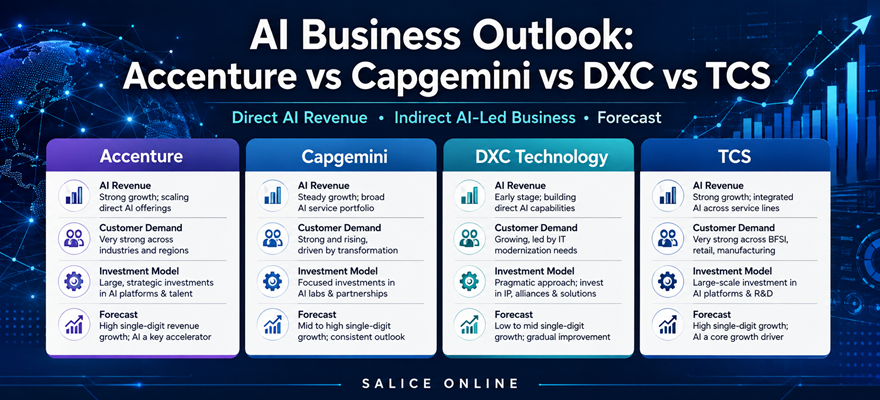
All four companies now describe AI and specifically agentic AI as the dominant force reshaping demand, deal structures and margins in enterprise IT services, but they are at different points in translating that narrative into disclosed financial results. Accenture and TCS report the most granular AI specific metrics (Advanced AI bookings and AI annualized revenue respectively), Capgemini discloses AI as a share of bookings, while DXC discloses no current period AI revenue figure at all, instead pointing to multiyear targets. Despite the shared optimism, the latest quarter told a more cautious story at three of the four companies. Accenture’s stock fell roughly 18-20% on a bookings miss and cautious guidance, Capgemini’s shares fell despite raising full year guidance as profit and cash flow deteriorated, and DXC continued to report organic revenue declines even as AI native bookings accelerated. TCS was the exception on demand commentary, insisting that widely reported IT spending contraction is not visible in their order book, even as its own margins were dented by wage increases and constant currency growth stayed modest.
A common thread across all four is the pairing of AI investment with workforce restructuring. Accenture cut roughly 11,000 roles in an AI linked restructuring while nearly doubling its AI and data workforce. Capgemini is cutting up to 2,400 roles in France and up to 748 in Spain explicitly citing AI and technological innovation. DXC’s headcount has fallen by an estimated 15,000 over two years alongside a formal AI driven cost reduction target of $1-1.5 billion by FY2029, and TCS’s roughly reduced 12,000 roles, AI-linked restructuring closed out fiscal 2026 even as the company begins hiring thousands of new AI focused engineers. Each company frames this as redeployment toward higher value AI work rather than simple downsizing, though external coverage is more skeptical.
A clear pattern emerges on partnerships. All four have struck alliances with frontier AI labs and hyperscalers. Anthropic (DXC, TCS), OpenAI (Capgemini), NVIDIA (TCS, Accenture ecosystem), Google Cloud/Gemini (TCS, Accenture), Mistral AI (Capgemini, TCS) and ServiceNow (all four, in some form) reflecting a shared strategic bet that no single model provider will win and that systems integrators must offer multi model, model agnostic orchestration layers to clients.
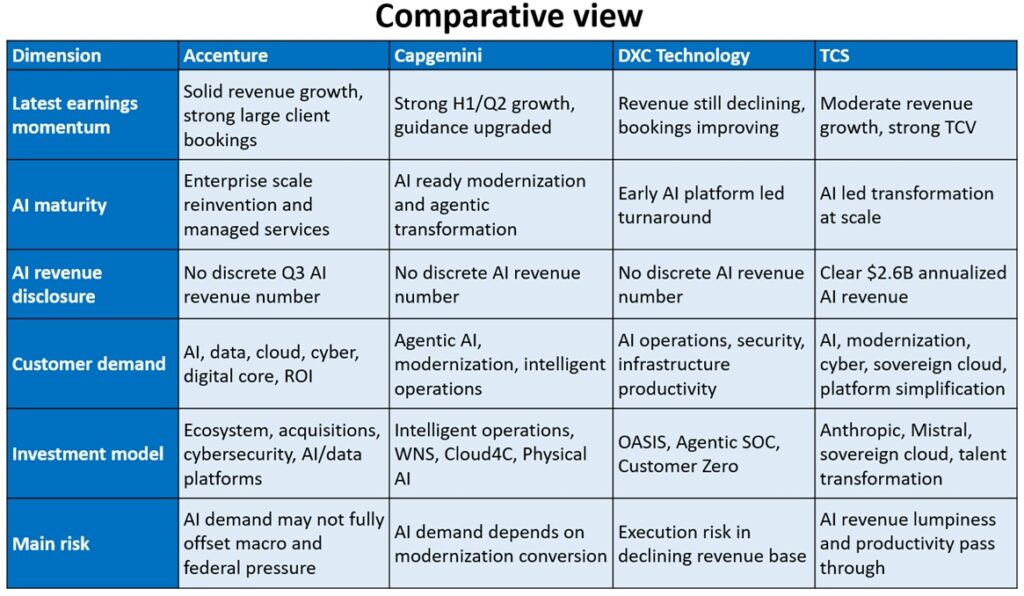
Based on the latest reported periods for Accenture Q3 FY2026, Capgemini H1 2026, DXC Technology Q1 FY2027 and TCS Q1 FY2027, the strongest common theme is that AI has moved from experimentation to enterprise scale transformation, but each company is monetizing and disclosing AI differently. Here is the comparative view
Bottom Line
Accenture leads in breadth and enterprise reinvention scale. Capgemini leads in the AI ready modernization narrative. DXC has the clearest AI turnaround story but still needs proof in revenue growth. TCS currently provides the strongest disclosed AI revenue evidence, with a rising AI annualized run rate and a broad partner ecosystem. Across all four, the market is moving from AI pilots to embedded, process level AI deployment, but the real constraint is no longer model access. it is data readiness, governance, modernization, security and organizational change.