- Staff Editor
- Follow Me
- May 31, 2026
-
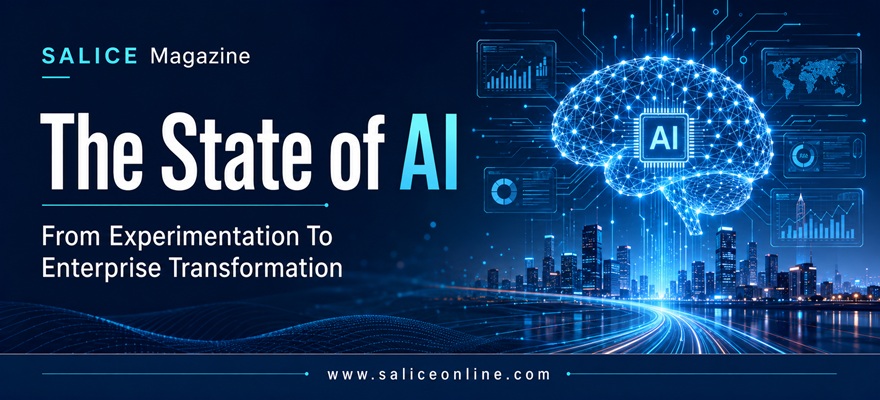
Generative AI is no longer a future prospect — it’s reshaping how organizations work, hire, and grow. The numbers tell a striking story of momentum and missed opportunity.
Something significant is happening inside the world’s largest companies. Boardrooms that once debated whether to invest in artificial intelligence are now debating how fast to move. According to the latest McKinsey Global Survey on AI published on March 2026, generative AI adoption has surged to levels that would have seemed implausible just two years ago and the gap between leaders and laggards is widening fast.
Artificial intelligence is entering a new phase. For the past few years, many organizations treated AI, especially generative AI, as an exciting tool for experimentation. Employees used it to write content, summarize information, support coding, improve customer service and speed up routine tasks. That early phase helped companies understand the possibilities. But the latest state of AI shows a bigger shift. organizations are now beginning to redesign how they work in order to capture real business value from AI.
The message is clear. AI adoption is growing, but adoption alone is not enough. The real winners will be organizations that connect AI to business outcomes, redesign workflows, build governance, manage risks and prepare their workforce for a new way of working.
AI Adoption Is Accelerating
AI use continues to grow across industries and business functions. More than three quarters of surveyed organizations now use AI in at least one business function. Generative AI adoption has also increased sharply, with organizations using it in areas such as marketing and sales, product development, IT, service operations and software engineering.
This shows that AI is no longer limited to technology teams. It is becoming part of everyday business operations. Marketing teams use it to create content and improve customer engagement. IT teams use it to increase productivity and support development work. Service teams use it to improve response times and knowledge access.
However, many organizations are still in the early stages of turning AI use into enterprise wide financial impact. This is an important distinction. Using AI tools is easy; capturing measurable value requires discipline, leadership and process change.
Workflow Redesign Is The Real Value Driver
One of the most important findings is that workflow redesign has a major influence on AI value. Companies cannot simply add AI tools on top of old processes and expect transformation. They must rethink how work is done.
For example, in customer support, AI should not only help agents write faster responses. It can redesign the full service process by summarizing customer history, suggesting next actions, identifying recurring issues and routing complex cases to the right expert. In software development, AI can support requirements, coding, testing, documentation and defect analysis.
The companies that benefit most from AI will be those that look beyond task automation. They will use AI to remove friction, reduce rework, improve decision-making and create faster end-to-end workflows.
Governance Is Moving To Senior Leadership
AI governance is becoming a boardroom and CEO level issue. As AI systems become more powerful, organizations need clear policies, processes and controls to ensure responsible use. Governance includes decisions around data privacy, security, accuracy, intellectual property, compliance and ethical use.
The survey shows that many organizations are placing senior leaders in charge of AI governance. This is a positive development because AI risk cannot be managed only at the tool level. It requires leadership accountability.
Good governance does not slow innovation. It creates trust. Employees need to know which tools they can use, what data they can share, when human review is required and how AI-generated outputs should be validated. Customers also expect companies to use AI responsibly, especially when personal data, financial decisions or customer facing content are involved.
Risk Management Is Becoming More Important
As AI adoption grows, so do AI-related risks. Organizations are paying more attention to issues such as inaccurate outputs, cybersecurity threats, intellectual property concerns, privacy exposure and explainability.
Generative AI can produce confident but incorrect answers. It can also create legal or reputational risks if employees use sensitive data carelessly or publish AI-generated content without review. This is why companies need stronger controls around AI outputs.
The level of human review still varies widely. Some organizations review all AI-generated content before it is used, while others review only a small portion. The right model may differ by industry and use case, but the principle is the same, AI should be helpful, but it should not remove accountability.
Large Companies Are Moving Faster
The survey indicates that larger companies, especially those with significant annual revenue, are moving faster in AI transformation. They are more likely to create AI road maps, establish governance models, build internal communication programs, hire AI talent and invest in structured training.
Large organizations may also have more complex processes and greater compliance requirements, which make AI governance and scaling more important. At the same time, smaller companies should not assume AI maturity is only for large enterprises. Smaller organizations can still move quickly by focusing on practical use cases, clear ownership and simple governance.
The key is not company size alone. The key is organizational readiness.
KPIs And Road Maps Are Essential
Many organizations are still not tracking well defined KPIs for AI solutions. This is a major gap. Without measurement, companies may not know whether AI is truly improving productivity, quality, cost, revenue, employee experience or customer outcomes.
AI projects should have clear success metrics from the beginning. Examples may include reduced processing time, faster response time, improved lead conversion, fewer errors, lower support cost, better customer satisfaction or higher employee productivity.
A clear road map is equally important. AI scaling should not be random. Companies need phased deployment plans, business ownership, training, change management and feedback loops.
AI Is Changing Workforce Skills
AI is also changing the skills organizations need. Companies are hiring AI data scientists, machine learning engineers, data engineers, AI compliance specialists and AI ethics specialists. At the same time, many organizations are reskilling existing employees so they can participate in AI deployment.
The future workforce will not be divided only between technical and nontechnical employees. Most professionals will need some level of AI literacy. They should understand how AI works, where it can help, where it can fail and how to use it responsibly.
AI may reduce some tasks, but it will also create new activities and new roles. In many cases, the time saved through automation can be redirected toward higher-value work, better analysis, customer engagement and innovation.
The Road Ahead
The state of AI shows that the market is moving from curiosity to capability. AI adoption is rising, but real value depends on how organizations change around the technology.
The next phase of AI will be defined by workflow redesign, strong governance, risk management, KPI discipline, workforce readiness and leadership ownership. Companies that treat AI as only a tool may see limited gains. Companies that treat AI as an operating model transformation will be better positioned to capture long-term value.
AI is no longer just about experimentation. It is becoming a measure of how prepared organizations are for the future of work, competition and business transformation.
Reference: This article is based on on the survey results published by Mckinsey titled “The state of AI: How organizations are rewiring to capture value” on 12th March 2026