- Staff Editor
- Follow Me
- September 1, 2026
-
How AI is changing who can build software, how developers work and what enterprise software engineering may look like in the future
Software development has traditionally required developers to translate business requirements into architecture, algorithms and programming languages. Generative AI is changing that relationship. Increasingly, developers can describe what they want in natural language and allow AI systems to generate, modify, test and debug substantial portions of an application.
This emerging development style is commonly called vibe coding. Instead of concentrating on individual lines of code, the human focuses on intent, what the application should do, how it should behave and what should change next.
Vibe coding can dramatically reduce the effort required to create prototypes, websites, internal tools and applications. However, generating working software is different from engineering reliable software. Security, architecture, scalability, testing and maintainability remain essential.
The significance of vibe coding therefore extends beyond faster programming. It represents a potential shift from code centric development toward intent driven software creation, changing the skills, tools and governance models surrounding software engineering.
The Evolution Before Vibe Coding
Vibe coding emerged from decades of increasingly abstract software development. Early programmers worked directly with machine instructions and assembly language, while higher-level languages such as C, Java and Python simplified much of that complexity. Integrated development environments later added debugging, autocomplete, reusable libraries and automation.
The next major shift came with AI-assisted coding. Tools such as GitHub Copilot showed that large language models could generate code, explain unfamiliar functions, create tests and troubleshoot errors inside development environments.
As AI models became more capable and gained access to repositories, terminals and execution tools, they moved beyond simple code completion. Developers could increasingly describe complete features in natural language and let AI handle much of the implementation.
This evolution created the foundation for vibe coding, software development began shifting from manually specifying every implementation detail toward expressing higher level intent to intelligent development systems.
The Birth Of The Term “Vibe Coding”
The term “vibe coding” was introduced by AI researcher Andrej Karpathy on February 2, 2025. He described a development approach in which programmers increasingly communicate desired outcomes to AI systems and allow the models to handle much of the underlying code.
The phrase captured something developers were already beginning to experience, increasingly capable large language models could create software through conversation rather than traditional line by line programming.
The original concept deliberately emphasized an informal style of development running the generated software, describing problems to the AI and repeatedly refining the application, sometimes without closely examining every code change.
The expression quickly became shorthand for a broader transformation in software development.
Importantly, vibe coding should not simply mean “using AI while programming.” AI-assisted development can remain highly disciplined. Vibe coding describes the point at which natural-language intent becomes the primary development interface and AI assumes much more responsibility for implementation.
How Vibe Coding Works
A typical vibe-coding workflow begins with an outcome rather than code.
A user might instruct an AI system:
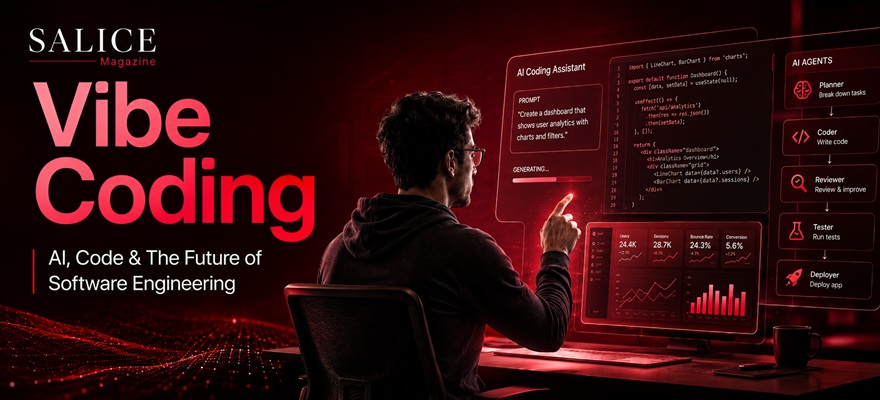
“Create a customer analytics dashboard with authentication, sales charts, filters and CSV export.”
The AI generates an initial implementation. The developer runs it and then provides conversational feedback:
“Move the filters to the left.”
“Add role-based access.”
“Fix the login error.”
“Make the dashboard work on mobile.”
The process becomes:
Idea → Prompt → Generate → Run → Review → Refine → Repeat
Modern coding agents can go further. They may inspect existing repositories, create implementation plans, modify multiple files, execute commands, debug failures and improve applications iteratively. Replit, for example, describes its Agent as capable of planning changes, writing code, explaining behavior and debugging applications.
The human increasingly becomes the director of the development process, while AI performs more implementation work.
Traditional Coding, AI-Assisted Coding And Vibe Coding
These approaches are related but fundamentally different.
Traditional coding places implementation primarily in the developer’s hands. Engineers design the solution, write the code, debug it and understand most implementation details.
AI-assisted coding retains that engineering model while using AI to accelerate activities such as autocomplete, code generation, testing, documentation, debugging and refactoring.
Vibe coding moves another level upward. The user primarily describes desired outcomes while the AI determines increasingly large portions of the implementation.
The emerging progression can therefore be viewed as:
Traditional Coding → AI-Assisted Coding → Vibe Coding → Agentic Engineering
The distinction matters. AI-assisted coding aims to make engineers more productive while maintaining engineering oversight. Pure vibe coding may prioritize working results and development speed even when the creator does not fully understand every generated implementation. For production environments, the most sustainable model is likely to combine the productivity of vibe coding with the discipline of professional software engineering.
Vibe Coding Ecosystem: Tools, LLMs and Programming Languages
The vibe-coding ecosystem combines AI-powered development platforms, large language models and traditional programming languages to enable software creation through natural language interaction.
Vibe coding tools generally fall into two categories. Prompt to application platforms such as Replit Agent, Lovable, Bolt and v0 allow users to move quickly from an idea to a working application with limited traditional coding. These tools are particularly attractive to entrepreneurs, designers and business users. AI native engineering environments such as Cursor, GitHub Copilot, Claude Code and Windsurf provide professional developers deeper access to repositories, terminals, existing architectures and enterprise codebases. The broader trend is moving from AI that merely suggests code toward AI that actively participates in the development lifecycle.
Behind these platforms are powerful large language models such as OpenAI GPT and Codex, Anthropic Claude, Google Gemini, Moonshot Kimi and other coding-focused models. Different models offer strengths in reasoning, code generation, speed, large context analysis or cost efficiency. Increasingly, development platforms support multiple models and may dynamically select the most appropriate model for planning, coding, debugging or reviewing software. As a result, competitive differentiation may shift from individual LLMs toward the orchestration layer that coordinates specialized AI models and development agents.
Vibe coding itself is not tied to any specific programming language. Modern AI coding systems support technologies including JavaScript, TypeScript, Python, Java, C#, C++, Go, Rust, Swift, Kotlin, PHP, Ruby, Dart, SQL and shell scripting. JavaScript and TypeScript dominate many web-focused platforms, while Python remains important for AI, automation, analytics and backend development.
Ultimately, the key limitation is often not whether an LLM understands a language, but whether the surrounding platform can execute, test, integrate, secure and deploy the generated application effectively.
Advantages of Vibe Coding
The biggest advantage of vibe coding is speed. Ideas can become working prototypes much faster than through conventional development, helping teams experiment and iterate quickly.
It also lowers the barrier to software creation. Entrepreneurs, analysts, designers and domain experts with limited programming experience can increasingly turn concepts into functional applications.
Experienced developers benefit as well. AI can automate boilerplate, UI generation, repetitive integrations, test creation and routine debugging, allowing engineers to focus more on architecture, complex problem-solving and system quality.
Vibe coding also reduces the cost of experimentation. Teams can build multiple alternatives, gather user feedback and abandon weak ideas before committing significant engineering resources.
For startups, this can be especially powerful by enabling smaller teams to test more ideas with less capital. Overall, vibe coding democratizes software creation while preserving the need for professional engineering discipline as products move toward production.
Disadvantages and Risks
he biggest risk of vibe coding is mistaking working software for production-ready software. AI-generated applications may contain security vulnerabilities, poor architecture, unnecessary dependencies, performance issues and hidden edge-case failures. Repeated AI-generated fixes can also create technical debt.
Another concern is maintainability: engineers may inherit large codebases they did not design and cannot fully explain. Weak testing, scalability issues, inconsistent documentation and intellectual-property concerns can further increase risk.
Overreliance on AI may also erode core programming and debugging skills. These risks become especially serious in healthcare, finance, automotive and industrial systems.
Code generation can be automated, engineering accountability cannot.
Industries Best Suited to Vibe Coding
Vibe coding delivers the most value where rapid experimentation matters and software failure carries manageable risk. Software and SaaS startups can use it for MVPs and feature testing, while marketing, e-commerce, consulting, education, media, real estate, travel and logistics can apply it to websites, dashboards, workflow tools and automation.
Manufacturing and automotive organizations can also use vibe coding for prototypes, engineering dashboards, test data tools and internal applications.
Higher-risk sectors such as healthcare, banking, aerospace, automotive and critical infrastructure require stronger governance, validation and engineering controls.
A practical rule is, the lower the consequence of failure, the more aggressively organizations can adopt pure vibe-coding workflows.
Vibe Coding: Disruption and the Future of Software Engineering
Vibe coding is likely to disrupt traditional coding practices more than AI assisted development because it represents the next stage of the same transformation. As AI increasingly handles syntax, boilerplate and predictable implementation tasks, skills such as problem decomposition, architecture, requirements definition, systems thinking, cybersecurity, testing, validation and technical judgment become more important. The shift also broadens who can build software, enabling product managers, entrepreneurs, analysts and designers to create applications directly. Professional developers will remain essential, but their role will increasingly move from writing every line of code toward directing intelligent systems and ensuring software is secure, scalable and maintainable. Looking ahead, natural language may become a standard programming interface, while multi-agent systems plan, code, test, debug and document software under human supervision. As software creation becomes cheaper and code more abundant, competitive advantage will increasingly depend on architecture, domain expertise, governance, validation and judgment. Ironically, better AI-generated code may make high-quality software engineering even more important.
Vibe coding is reshaping how humans create software by allowing AI to translate intent directly into implementation. It expands who can build applications and accelerates development, but it does not replace professional engineering. Software must still be reliable, secure, maintainable and fit for purpose. The strongest organizations will combine AI-driven speed with disciplined architecture, testing, cybersecurity and governance. As code generation becomes easier, the real differentiators will be problem definition, technical judgment, system design and accountability. The future belongs not to those who write the most code, but to those who direct intelligent systems responsibly.