
- Staff Editor
- Follow Me
- October 18, 2026
-
Artificial intelligence has moved well beyond experimentation and now plays an increasingly important role in business transformation. Organizations across industries are investing heavily in generative AI, machine learning, intelligent automation, and AI solutions to improve productivity, accelerate innovation, and strengthen their competitive position. However, as AI adoption grows, many enterprises face a fundamental challenge. How can they move beyond isolated AI initiatives and establish a scalable, secure, and sustainable foundation that supports AI adoption across the organization?
This challenge brings AI Platform Strategy into focus.
AI Platform Strategy describes how an organization plans, develops, integrates, and manages the technology infrastructure, data ecosystems, AI models, and operational capabilities needed to deploy artificial intelligence at scale. Instead of developing separate AI applications for individual business functions, organizations can establish a common framework that allows different departments to share AI capabilities while maintaining flexibility, security, interoperability, and cost efficiency.
An effective AI Platform Strategy goes far beyond choosing the right technologies. Organizations must make important decisions about cloud and edge infrastructure, data architecture, foundation models, MLOps and LLMOps, AI governance, cybersecurity, vendor partnerships, and the choice between proprietary and open source technologies. They must also connect these decisions to business priorities and ensure that investments in AI deliver measurable operational and commercial benefits.
Industries such as automotive, manufacturing, healthcare, financial services, and retail can use a common AI platform to accelerate innovation through reusable AI components, intelligent workflows, real time analytics, and applications tailored to specific business needs.
As organizations move from AI experimentation to broader enterprise adoption, access to advanced AI models alone will not determine their competitive advantage. Their ability to integrate AI into everyday operations, manage costs, maintain governance, and scale successful applications will matter far more.
AI Platform Strategy goes beyond a technology roadmap. It provides a foundation for managing AI as a long term business capability, improving operational efficiency, strengthening governance, and creating sustainable competitive advantage.
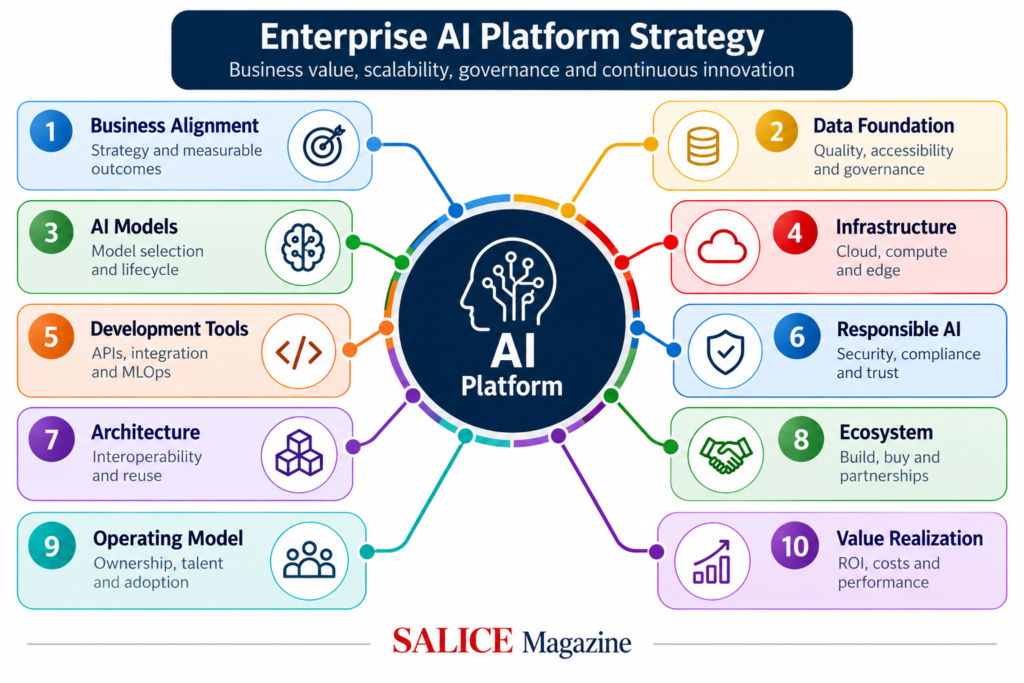
1. Business Strategy and Value Alignment
A successful AI Platform Strategy must begin with clear business objectives and measurable outcomes. Organizations should align AI investments with strategic priorities such as improving productivity, reducing operational costs, enhancing customer experiences, increasing revenue, and strengthening competitive advantage. Business requirements must guide technology choices to ensure that AI delivers practical value rather than becoming an isolated technology initiative.
Identifying and prioritizing use cases plays an important role in this process. For example, manufacturers can use AI for predictive maintenance, banks can improve fraud detection, and retailers can personalize customer experiences. Organizations should evaluate these opportunities based on business impact, implementation feasibility, data availability, and expected return on investment.
Leadership must also decide which capabilities to develop internally, which to acquire from external providers, and how to fund and manage the platform. Clear ownership, performance indicators, and regular reviews help ensure that AI investments consistently support business growth and long term strategic goals.
2. Data Foundation and Management
Data forms the foundation of every successful AI platform. Organizations must establish reliable processes to collect, integrate, organize, and manage data from multiple sources, including enterprise applications, operational systems, customer interactions, and external platforms. A strong data foundation ensures that AI models receive accurate, relevant, and timely information to generate meaningful insights and support business decisions.
Effective data management requires standardized data pipelines, quality controls, metadata management, and seamless integration of structured and unstructured information. Organizations should also establish clear data ownership, access controls, and governance policies to maintain consistency, security, and regulatory compliance.
Modern data architectures, including data lakes, warehouses, and lakehouses, can support diverse AI workloads and enterprise scalability. Organizations must continuously monitor data quality, eliminate duplication, and address inconsistencies that could affect model performance.
A well managed data foundation improves AI reliability, reduces operational risks, and enables organizations to develop and scale AI applications across business functions.
3. AI Models and Lifecycle Management
Organizations must establish a consistent approach to selecting, developing, customizing, deploying, and maintaining AI models throughout their lifecycle. An effective AI platform should support traditional machine learning, deep learning, foundation models, generative AI, and agentic AI systems. Model selection should consider business requirements, accuracy, performance, scalability, security, and operational costs.
Organizations can develop proprietary models, adopt open source technologies, or integrate commercial models from external providers. Techniques such as fine tuning and retrieval augmented generation can help adapt models to specific business needs. A flexible architecture should support multiple model providers and allow organizations to upgrade or replace models without disrupting existing applications.
Effective lifecycle management requires systematic testing, evaluation, version control, deployment, and continuous monitoring. MLOps and LLMOps practices help automate these processes while maintaining model reliability and operational consistency. Regular performance reviews enable organizations to identify model degradation, manage risks, optimize costs, and sustain business value as AI technologies evolve.
4. Infrastructure and Computing Strategy
A successful AI Platform Strategy requires a reliable and scalable computing infrastructure that supports model training, inference, data storage, and enterprise applications. Organizations must evaluate infrastructure options based on business requirements, workload complexity, performance expectations, and financial considerations.
Public cloud platforms offer flexibility and rapid scalability, while private cloud and on premises infrastructure provide greater control over sensitive data and computing resources. Hybrid architectures combine these advantages, allowing organizations to distribute workloads according to operational needs. Edge computing enables faster processing near data sources, particularly for applications that require immediate decisions.
Organizations should also assess computing resources such as GPUs, storage capacity, networking capabilities, and energy efficiency. Infrastructure planning must address system availability, cybersecurity, disaster recovery, and future expansion.
An effective infrastructure strategy balances performance, scalability, reliability, and cost. It also prevents unnecessary technology investments while ensuring that AI applications operate efficiently as business demands and computing requirements evolve.
5. AI Development, Integration and Operations
AI Development, Integration and Operations focuses on building, deploying, and managing AI applications across the enterprise. Organizations must establish common development environments, tools, and processes that help teams move AI solutions from experimentation to production efficiently and reliably.
Development teams should use standardized APIs, reusable components, and orchestration frameworks to integrate AI capabilities with existing business applications. Automated testing and continuous integration practices help teams identify defects, maintain quality, and accelerate deployment. MLOps and LLMOps provide structured approaches to managing model updates, version control, deployment pipelines, and operational performance.
Organizations must also monitor AI applications for accuracy, response quality, system availability, latency, and operating costs. Clear operational ownership and incident management procedures help teams address failures and maintain service continuity.
A consistent development and operations framework reduces duplication, improves collaboration, shortens implementation cycles, and enables organizations to scale AI applications while maintaining reliability, security, and operational efficiency.
6. AI Governance, Security and Responsible AI
As organizations expand AI adoption, they must establish governance frameworks that protect business interests, customer information, and public trust. AI governance should define clear policies for data privacy, cybersecurity, intellectual property, regulatory compliance, and responsible AI practices. These policies must guide every stage of the AI lifecycle, from model selection and development to deployment, monitoring, and retirement.
Organizations should assess potential risks such as biased decisions, inaccurate outputs, unauthorized data access, and misuse of AI capabilities. Regular audits, security testing, and model evaluations help identify vulnerabilities before they affect business operations. Human oversight remains essential, particularly when AI influences financial decisions, healthcare services, employee assessments, or customer interactions.
Leadership teams must assign accountability, establish approval procedures, and maintain documentation of AI applications and their associated risks. A strong governance framework allows organizations to innovate confidently while maintaining transparency, regulatory compliance, operational security, and stakeholder trust.
7. Platform Architecture, Interoperability and Scalability
A successful AI platform requires an architecture that connects different models, applications, data sources, and enterprise systems without creating unnecessary complexity. Organizations should adopt modular designs that allow technology teams to develop, replace, and expand individual components without disrupting existing operations.
Standardized APIs, reusable services, and common integration frameworks enable seamless communication between AI applications and business systems. For example, an organization can connect AI models with ERP, CRM, manufacturing systems, and customer service platforms through shared interfaces. This approach reduces duplication and allows multiple business functions to benefit from common AI capabilities.
Scalability also plays an important role as organizations expand AI adoption. Platform architects must consider computing requirements, workload distribution, response times, system availability, and future technology changes. Support for multiple model providers and deployment environments helps organizations maintain flexibility and reduce vendor dependency. A modular architecture supports faster innovation, easier maintenance, and sustainable enterprise growth.
8. Technology Ecosystem and Partnership Strategy
Organizations rarely possess every technology, skill, and infrastructure capability required to develop a comprehensive AI platform independently. A strong ecosystem strategy helps organizations access specialized expertise, accelerate innovation, and manage technology investments effectively.
Leadership teams must evaluate which capabilities they should develop internally and which they should acquire through external partnerships. Cloud providers, AI model developers, software companies, system integrators, and research institutions can contribute different capabilities to the platform. Organizations should assess potential partners based on technical expertise, security standards, commercial terms, service reliability, and future development plans.
Vendor dependency requires particular attention. Organizations should prioritize interoperability, data portability, flexible licensing, and clear intellectual property agreements to protect their long term interests. They should also review partner performance regularly and explore alternative technologies when necessary.
An effective partnership strategy combines internal expertise with external innovation, reduces implementation risks, and allows organizations to respond quickly to changing business and technology requirements.
9. Organizational Operating Model, Talent and Adoption
A successful AI platform requires more than technology investments. Organizations must establish an operating model that defines ownership, decision making responsibilities, and collaboration between business functions and technology teams. Without clear accountability, even advanced AI platforms may struggle to achieve meaningful adoption.
Many organizations establish an AI Center of Excellence to coordinate platform standards, technical expertise, governance, and knowledge sharing. Business units can then identify relevant use cases, define operational requirements, and implement AI applications using common platform capabilities.
Employee skills and organizational readiness also influence adoption. Companies should invest in AI literacy, technical training, leadership development, and practical learning opportunities. Change management programs must address employee concerns, explain how AI supports existing responsibilities, and encourage participation in implementation activities.
Organizations should track adoption rates, employee feedback, productivity improvements, and business outcomes. Clear communication, executive sponsorship, and collaboration across departments help establish an organizational culture that supports responsible AI adoption and continuous learning.
10 Financial Sustainability, Performance and Continuous Improvement
Organizations must evaluate the financial sustainability of their AI platforms alongside technical performance and business outcomes. As AI adoption expands, infrastructure expenses, model licensing fees, computing resources, and operational support costs can increase significantly. A disciplined financial management approach helps organizations maintain control over these investments.
Leadership teams should establish measurable indicators for platform utilization, application performance, development productivity, operational efficiency, and return on investment. Technology teams must monitor GPU utilization, token consumption, inference costs, storage expenses, and computing efficiency to identify opportunities for optimization.
Organizations should also compare actual business outcomes against the objectives they established during use case selection. Regular performance reviews help identify applications that deliver measurable value and those that require improvement or retirement.
Continuous improvement requires organizations to reassess technology choices, optimize existing models, incorporate user feedback, and evaluate emerging capabilities. By combining financial discipline with operational monitoring, organizations can sustain AI investments, improve platform efficiency, and strengthen their competitive position over time.
Conclusion
A successful AI Platform Strategy requires organizations to move beyond individual AI applications and establish a common foundation that supports innovation, scalability, security, and sustainable business growth. The ten pillars provide a comprehensive framework for aligning AI investments with business priorities, managing data and models, building reliable infrastructure, strengthening governance, and developing organizational capabilities. However, technology alone cannot guarantee success. Organizations must identify practical use cases, establish clear accountability, develop employee skills, and continuously measure business outcomes. As AI technologies evolve, organizations must maintain flexibility in platform architecture, model selection, and technology partnerships. A well executed strategy can reduce duplication, control costs, accelerate innovation, and create lasting business value.
The real measure of an AI Platform Strategy lies not in the sophistication of its technology or the scale of its investments, but in its ability to turn AI into a trusted, reusable, and economically sustainable enterprise capability. Organizations that establish this foundation will move beyond isolated experimentation and make AI an integral part of how they operate, innovate, and create value.