
- Staff Editor
- Follow Me
- September 7, 2026
-
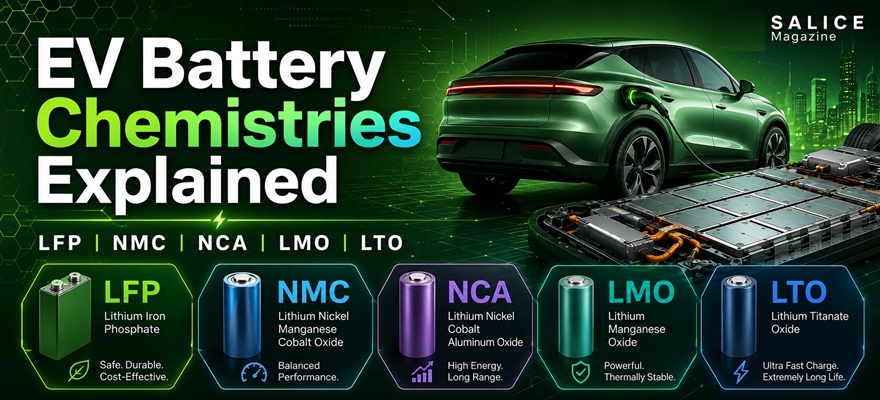
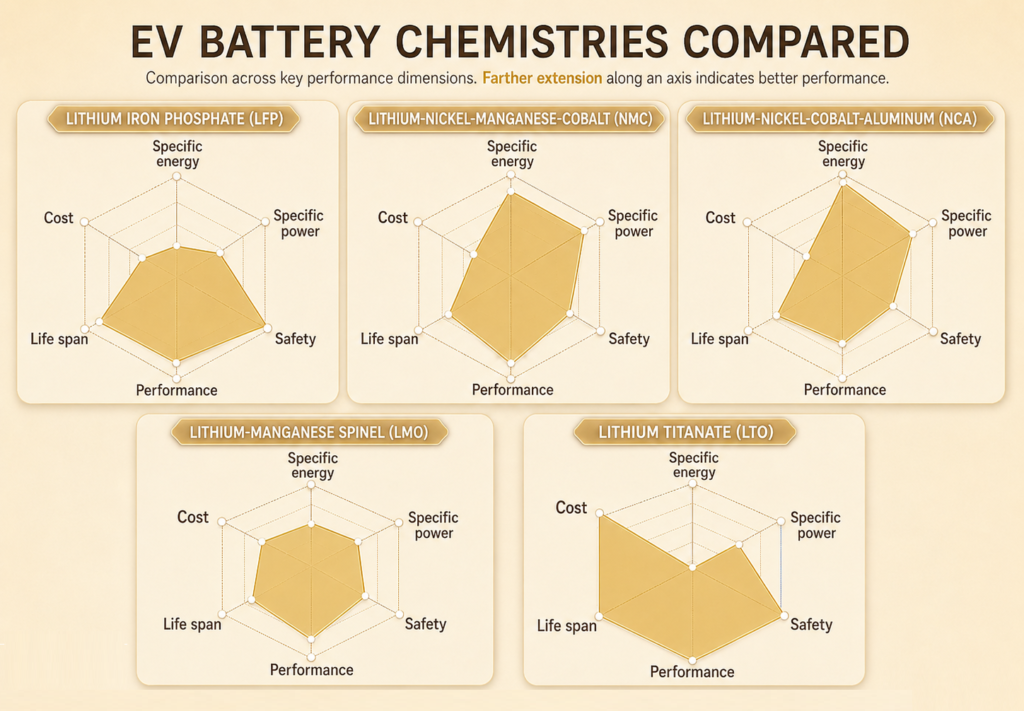
Electric vehicle performance depends heavily on battery chemistry. The material combination inside a lithium ion cell influences range, charging speed, power delivery, safety, cost and battery life. The comparison shown in the following image highlights five important chemistries say, LFP, NMC, NCA, LMO and LTO. No single chemistry is best in every category. Automakers choose batteries according to vehicle segment, performance targets, cost structure, supply chain and regional market needs. As EV adoption expands, these chemistry choices are becoming a major source of competitive differentiation.
Lithium Iron Phosphate (LFP)
Lithium iron phosphate, or LFP, has become especially important in China and is expanding rapidly into Europe and other global markets. Its popularity comes from strong thermal stability, long cycle life and comparatively lower cost because it avoids nickel and cobalt. Its main disadvantage is lower energy density than high nickel chemistries, which can mean a heavier battery for the same range. China’s BYD is one of the strongest advocates of LFP through its Blade Battery, used across vehicles such as the BYD ATTO 3, Dolphin and other models. BYD says its Blade Battery uses LFP and emphasizes safety, durability and long service life. Tesla also uses LFP cells in selected standard range vehicles, while Volkswagen is introducing LFP versions of its Unified Cell in models such as the ID. Polo and ID. Cross. LFP is therefore becoming attractive for mainstream EVs where affordability, durability and safety are more important than maximum energy density
Nickel Manganese Cobalt (NMC)
NMC, or nickel manganese cobalt, is one of the most widely used EV battery chemistries and has been particularly important across Europe, South Korea, North America and China. Its strength is balance. Nickel supports high energy density, manganese contributes stability and cobalt supports durability and performance. This combination makes NMC suitable for vehicles where manufacturers need longer range without excessively increasing battery size or weight. European and Korean automakers have relied heavily on variants of NMC, while battery manufacturers such as LG Energy Solution, Samsung SDI and SK On have built significant expertise around nickel rich chemistries. Volkswagen, for example, is using an NMC version of its Unified Cell for higher capacity versions of the ID. Polo and ID. Cross, where greater energy density supports longer range than the corresponding LFP packs. Tesla also identifies high nickel layered oxides such as NMC as relevant to its higher energy cells. NMC remains attractive for premium and long range EVs because it provides a strong compromise among energy, power and overall performance.
Nickel Cobalt Aluminum (NCA)
NCA, or lithium nickel cobalt aluminum oxide, became highly visible through Tesla and Panasonic and has been particularly associated with North American premium and long range EV applications. Its major advantage is very high specific energy, allowing manufacturers to store substantial energy without making the battery excessively heavy. This has historically made NCA attractive for vehicles where range and acceleration are key selling points. Panasonic developed high energy cylindrical lithium ion cells that became closely associated with Tesla’s early battery strategy, and NCA type chemistry has been used in several generations of Tesla vehicles, including versions of the Model S, Model X, Model 3 and Model Y depending on production location, pack generation and supplier. The trade off is that high nickel chemistry requires sophisticated thermal management and battery control systems. NCA therefore fits applications where manufacturers are willing to invest in advanced pack engineering to obtain high energy density and strong performance. Increasingly, however, automakers are diversifying toward NMC and LFP depending on vehicle price and range requirements.
Lithium Manganese Oxide (LMO)
LMO, or lithium manganese oxide, played an important role during the early development of mass market electric vehicles, particularly in Japan. Its spinel structure provides good power capability and reasonable thermal stability, while manganese is relatively accessible and less expensive than cobalt heavy alternatives. However, LMO generally offers lower energy density and shorter cycle life than newer NMC, NCA and LFP solutions, which has reduced its importance in modern long range EVs. Nissan provides one of the best known examples, the first generation Nissan LEAF used a manganese based cathode, while later LEAF batteries moved toward nickel-cobalt-manganese chemistry to obtain higher energy density. LMO or LMO rich blends were also used in earlier electrified vehicles such as versions of the Chevrolet Volt. Today, pure LMO is far less common in mainstream EVs and is more likely to appear in blended chemistries or specialized applications. Its history illustrates how quickly battery technology has evolved as manufacturers pursue greater range and durability.
Lithium Titanate (LTO)
LTO, or lithium titanate, takes a different approach from most EV batteries because lithium titanate is typically used in the anode rather than defining the cathode. Its strongest characteristics are exceptional cycle life, rapid charging, high safety and strong low temperature performance. The main disadvantages are relatively low energy density and high cost, which make it less suitable for long range passenger EVs where maximum range per kilogram is critical. LTO has therefore been most visible in Japan and in specialized vehicles where durability and rapid charging matter more than pack size. Toshiba’s SCiB battery is a prominent example. Mitsubishi selected SCiB for versions of the i-MiEV and MINICAB-MiEV, citing rapid charge/discharge capability, long life and low temperature performance. Honda also selected Toshiba SCiB batteries for the Fit EV, launched in Japan and the United States. These characteristics make LTO particularly interesting for commercial fleets, buses, industrial mobility and other applications with frequent charging cycles, even though it remains a niche technology for mainstream passenger EVs.
Choosing the Right Battery Is a Vehicle Strategy
The EV battery market is increasingly moving away from the idea that one chemistry will dominate every vehicle. LFP is gaining strength where cost, safety and longevity matter. NMC and other high nickel chemistries remain important where range and energy density are priorities. NCA has demonstrated the performance potential of high energy cells while LMO and LTO illustrate valuable solutions for specific performance requirements. Future EV platforms will likely use multiple chemistries across different models and markets. The real competitive advantage for automakers will therefore come from matching the right battery chemistry with the right vehicle architecture, customer need, manufacturing strategy and supply chain.