
- Staff Editor
- Follow Me
- June 1, 2026
-
Imagine calling a taxi, getting in, and watching the steering wheel move on its own. No driver. No small talk. Just a smooth, software-guided ride to your destination. That is not science fiction. It is already happening in Phoenix, San Francisco, Wuhan, and a growing number of cities around the world.
Robotaxis, a fully autonomous vehicles that carry passengers without a human driver are one of the most significant shifts in how cities move people. They are not common yet, but they are no longer rare either. Understanding where they came from, who is building them, and what still needs to go right is important for anyone watching the future of transport, technology, and urban life.
From cruise control to no driver at all
The story of robotaxis did not begin with a grand invention. It began with small steps. Early vehicles got cruise control, then parking sensors, then lane keeping systems. Each feature removed one small task from the driver’s hands. Over time, these became known as advanced driver-assistance systems, or ADAS, the building blocks of fully autonomous driving.
The real turning point came in the 2000s, when companies like Google began testing self-driving cars on public roads. Most early vehicles still had a human safety driver in the seat, ready to take over. The breakthrough was narrowing the challenge: instead of trying to drive everywhere, companies focused on carefully mapped urban zones, geofenced areas where they could control conditions, collect data, and gradually build confidence. That strategy turned an enormous engineering problem into a manageable one.
“Robotaxis may not simply replace taxis. They may become one layer of a broader autonomous mobility network that connects airports, transit, and business districts.”
Where Robotaxis Are Deployed Today
The two most active robotaxi markets today are the United States and China, and both are moving fast.
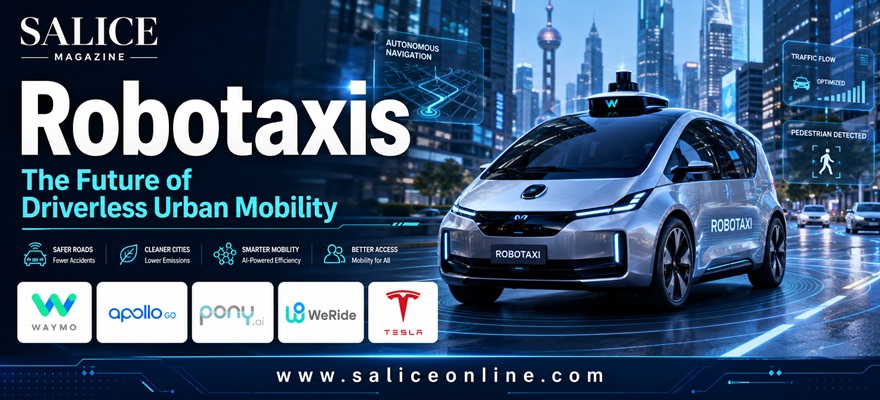
In the U.S., Waymo owned by Alphabet, Google’s parent company is the clear frontrunner. It operates commercial robotaxi services in Phoenix, San Francisco, Los Angeles, and Austin, with a fleet reported to exceed 3,000 vehicles. Riders book through an app, get in, and arrive at their destination without ever interacting with a human driver. Tesla is also building toward a robotaxi future, though its commercial fleet remains far smaller. Amazon-backed Zoox is developing purpose-built autonomous vehicles designed from the ground up for ride-hailing.
In China, Baidu Apollo Go, Pony.ai, and WeRide are the major players. These companies are operating in cities including Wuhan, Beijing, Guangzhou, and Shanghai. Pony.ai has reported a fleet of over 1,700 robotaxis and is targeting more than 3,500 vehicles by the end of 2026. WeRide reported over 1,000 vehicles globally in January 2026 and expects that number to exceed 2,600 by year-end.
Beyond these two markets, early activity is emerging in the United Arab Emirates, Singapore, South Korea, Qatar, and parts of Europe where smart-city ambitions and government support create a good environment for testing and scaling.
Why this matters beyond the technology
The appeal of Robotaxis goes well beyond novelty. If the technology reaches maturity, the implications for cities and societies are significant. Removing the driver from the equation could substantially reduce the cost of ride-hailing, making it more accessible. Autonomous vehicles could also provide mobility to people who currently have no good options like elderly residents who can no longer drive, people with disabilities, and communities underserved by public transport.
There is also a safety argument. Human error is involved in the vast majority of road accidents. A well designed autonomous system does not get tired, distracted, or impaired. That potential is a compelling reason why governments and investors are watching this space so closely.
The real obstacles to wider adoption
Progress is real, but so are the challenges. Safety remains the highest bar. City roads are unpredictable, construction zones, cyclists, emergency vehicles, unusual weather, and unexpected human behavior all push autonomous systems to their limits. A single high profile incident can slow an entire industry’s expansion and trigger tighter regulation.
Public trust is another barrier that cannot be engineered away. Many passengers remain uncomfortable sitting in a vehicle with no driver. Questions around who is responsible if something goes wrong, how the vehicle behaves in an emergency, and what happens to personal data all affect whether people choose to use the service. Operators must earn that trust, one ride at a time.
Cost is also a major constraint. Robotaxis require expensive sensor arrays, computing hardware, detailed mapping, remote support infrastructure, insurance, charging, and maintenance. Building a profitable business at scale is not just in a pilot zone, it is still an open question for the industry.
Weather, too, plays a role. Robotaxis perform best in clear, well-mapped urban environments. Snow, heavy rain, fog, and glare all reduce reliability. This is one reason deployment is likely to grow fastest in cities with favorable climates and well-maintained road infrastructure.
What the next decade looks like
The trajectory is clear, even if the pace is uncertain. Between now and 2030, Robotaxis are likely to expand from limited pilots into larger commercial networks in selected cities particularly around airports, business districts, and planned smart city zones. After 2030, broader adoption becomes more realistic as fleets grow, costs fall, and public trust builds.
The market potential is large. Goldman Sachs projects the global robotaxi market could reach approximately $415 billion by 2035, with the U.S. portion alone estimated at $48 billion. These numbers reflect genuine optimism, but they depend on continued progress across technology, regulation, cost reduction, and public acceptance.
For business leaders, urban planners, and technology companies, the message is straightforward. Robotaxis are not a distant experiment. They are an emerging mobility business that will shape how cities are designed, how software platforms compete, and how people experience everyday transport. The companies and cities that prepare thoughtfully for that shift are likely to benefit most when it arrives.